Showing posts with label Wind Generators. Show all posts

Wednesday, February 02, 2011

Magenn Air Rotor System (M.A.R.S.)

MARS is a lighter-than-air tethered wind turbine that rotates about a horizontal axis in response to wind, generating electrical energy. This electrical energy is transferred down the 1000-foot tether for immediate use, or to a set of batteries for later use, or to the power grid. Helium sustains MARS and allows it to ascend to a higher altitude than traditional wind turbines. MARS captures the energy available in the 600 to 1000-foot low level and nocturnal jet streams that exist almost everywhere. MARS rotation also generates the "Magnus effect" which provides additional lift, keeps the MARS stabilized, and positions it within a very controlled and restricted location to adhere to FAA (Federal Aviation Administration) & Transport Canada guidelines.


Magenn Power draws on over 31 years of research and development in advance materials and structure. It all began with designing the Magnus Spherical Airship starting in 1978. Fred Ferguson (founder of Magenn Power) patented the Magnus Airship in the 1980s. This unique airship utilized the Magnus effect for the first time in lighter-than-air craft. This Magnus Airship was a large spherical envelope filled with helium to achieve static, buoyant lift. As the sphere rotated during forward motion, Magnus lift was generated proportional to the airspeed flowing over the sphere; the faster the vehicle, the higher the Magnus lift.


The huge sphere rotated backwards as the craft flew forward. The resulting lift at cruise speed was greater than the total buoyant lift which could be up to 60 tons payload depending upon the final production size. As wind speed increases, rotation increases, lift increases, drag will be minimized because of reduced leaning, and stability increases. This airship design was fully patented world-wide and was developed over a decade.


In the early 1990's, Fred Ferguson then formed Av-Intel Inc., a small private company with a group of prominent financiers from US industry. The new Av-Intel airships encompass an advanced new technology that divides the long cigar-shaped airship into sections or segments that act similar to a huge shock absorber. In simulation studies contracted to the Lockheed Advanced Development Corporation, Av-Intel's design proved to exceed the current requirements for safety and gust loading by a broad positive margin.
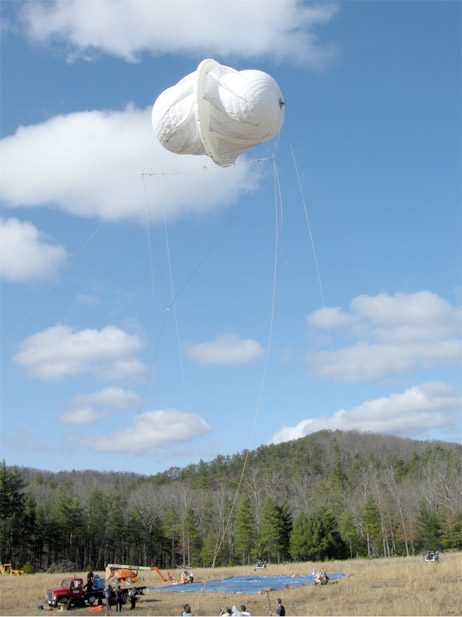

In April of 2008, Magenn Power made history by having the world's first rotating airship. This MARS Alpha prototype generated 2kW of electrical power; further testing is being done to bring the power output to 10 to 12 kW. (Size of MARS above is 29.5 feet by 57 feet).

The device rotates about a horizontal axis in response to wind, efficiently generating clean renewable electrical energy at a lower cost than all competing systems. This electrical energy is transferred down the tether to a transformer at a ground station and then transferred to the electricity power grid. Helium (an inert non-reactive lighter than air gas) sustains the Air Rotor which ascends to an altitude for best winds and its rotation also causes the Magnus effect. This provides additional lift, keeps the device stabilized, keeps it positioned within a very controlled and restricted location, and causes it to pull up overhead rather than drift downwind on its tether.


More Info:
www.magenn.com

Saturday, February 09, 2008

HYmini


The HYmini is a a hybrid universal charger and adapter gadget that that fits in the palm of your hand and uses a combination of wind, solar, hand-cranking, USB outlets and conventional wall plug power (100~240V wall plug) to recharge just about any 5V digital gadgets.

The recharge is done through its USB 2.0 outlet by inserting the USB transfer cable provided to connect HYmini and the gadget.
You can also use the original manufacture USB core to recharge your devices (iPods, MP3 players, cameras, etc)

Various adaptors included in the HYmini Basic Package allow you to charge a great number of mobile phones.

  • Micro wind power generator

    Built-in to the portable power unit as a supplemental power source with a 65 mA capacity. Translucent, removable and impact safe wind turbine that glows green when charging. Minimum of 9mph wind speed to start charging.

    icon
  • LED night light, and charge-in green indicator

    Generate electricity during everyday activities.

    icon
  • 1200 mAh built in lithium ion polymer rechargeable battery power bank.

    5V adaptive 200~850mA output through USB 2.0.
    Built-in rechargeable battery inside the casing.

    icon
  • Hybrid Recharger

    Rechargeable through 100~240V wall pug, DC jack, miniSOLAR panels, hand crank generator and hydro generator.

    icon


Available from:
HYmini

Sunday, October 21, 2007

Third World Wind Power

Shawn Frayne is a 26-year-old inventor based in Mountain View, California, winner of the Popular Mechanics 2007 Breakthrough Award, who has devised a way to harness the potential of wind without the need for conventional wind turbines.


As Frayne explains, conventional wind turbines don’t scale down well because there’s too much friction in the gearbox and other components: "With rotary power, there’s nothing out there that generates under 50 watts".

The Windbelt gets around these problems by putting aside rotation entirely. Instead, a method has been developed by which a taut, vibrating membrane, coupled with a no-contact, direct-drive electrical generator, can tap the energy of flowing air.

By studying the way vibrations caused by the wind (aeroelastic flutter) led to the collapse in 1940 of Washington’s Tacoma Bridge, Frayne came up with the idea for the Windbelt, which is basically a taut membrane fitted with a pair of magnets that oscillate between metal coils.


The Windbelt is the world’s first turbine-less wind generator -- a completely new way to look at wind power which is changing the landscape of the field.
Prototypes have been capable of generating 40 milliwatts in 10-mph slivers of wind, making his device 10 to 30 times as efficient as the best microturbines and enough to power LED lamps and radios.

The Windbelt technology was originally conceived in 2004, during a trip to Petite Anse, Haiti. This fishing village near the coast was not connected to an electrical grid, and the only lighting available was diesel-powered or kerosene-based.

The Windbelt fulfilled its original design criteria while demonstrating 10x the efficiency of the state-of-the-art in micro-turbine technology on these scales.
Now, Humdinger is poised to take this technology and apply it to a wide array of fields, from rural lighting to energy harvesting for wireless sensors in ‘smart buildings’.

Peter Haas, founder of the Appropriate Infrastructure Development Group, which helps people in developing countries to get environmentally sound access to clean water, sanitation and energy, and has a whole section of their website dedicated to WindMills, sees many advantages in Frayne's invention: “If Shawn’s innovation breaks, locals can fix it. If a solar panel breaks, the family is out a panel.”
“There’s not a huge amount of innovation being done for people making $2 to $4 per day,” Haas added. “Shawn’s work is definitely needed.”